
Five Questions to Ask Before You Trust a Source
You found a source that might help answer your question. But what’s next? The next step is figuring out whether that source is actually worth using. That sounds obvious, but it is easy to skip. We find something that looks polished, matches what we were hoping to find, or appears near the top of a search result, and we move on. (Been there, done that. Oops!)
A quick evaluation can tell you a lot about whether that information deserves your trust. There are many ways to evaluate information, but five questions are especially useful places to start: Is it current? Who created it? Can it be verified? What perspective does it represent? Is it relevant to what you actually need?
These are only a handful of the filters you can use when evaluating a source, but they are some of the ones I come back to most often.
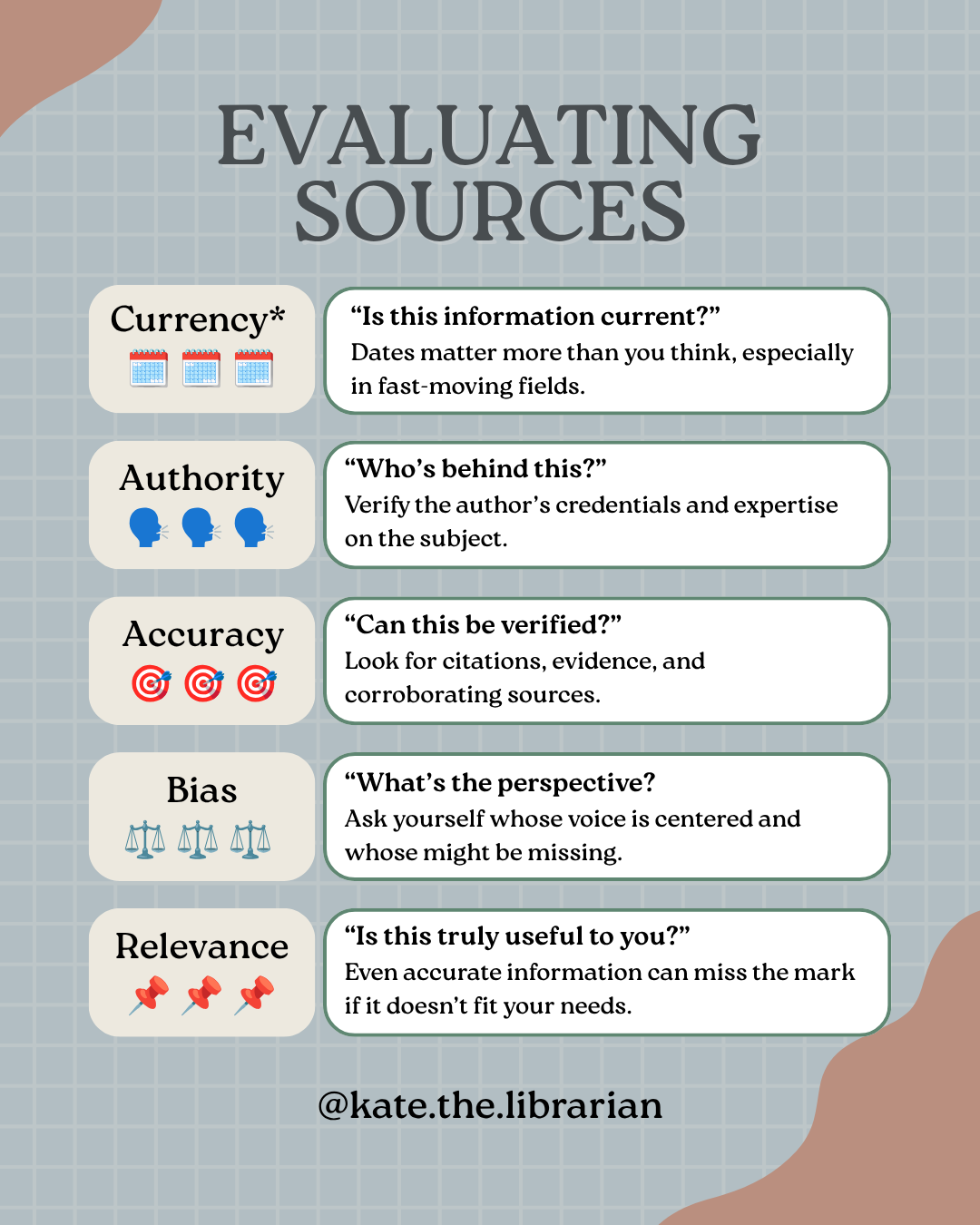
Currency: Is this information current?
Currency refers to how recent the information is and whether that matters for the topic you are researching. Some information ages slowly. A historical document may still be perfectly useful decades later. Other information can become outdated very quickly, especially in areas like technology, health, law, or current events.
Check the publication date, look for updates, and pay attention to whether the source is discussing information that may have changed since it was published.
And yes, currency means more than money.
Authority: Who is behind this?
Look at who created the information and what qualifies them to speak on the subject. That might mean checking an author’s credentials, professional experience, organization, or other work.
Authority can also depend on context. Someone may be highly qualified in one area and still be outside their expertise in another. A title or impressive bio can tell you something, but the expertise should actually connect to the topic you are researching.
Accuracy: Can this be verified?
A strong source should give you some way to check the information it presents. Look for citations, links to original material, supporting evidence, or corroboration from other reliable sources.
You should be able to follow important claims back to the evidence, source material, or reporting that supports them.
Bias: What perspective is represented?
Every source comes from a particular perspective. Just because something has a bias doesn't make it useless. You just need to examine the author’s perspective.
Ask whose voice is highlighted, what assumptions are being made, what interests may be involved, and whose perspective might be missing. Understanding that context helps you recognize the lens through which the information is being presented. Perfect neutrality is difficult to find, so knowing a source’s perspective can help you evaluate how much weight to give it.
Relevance: Is this actually useful to you?
A source can be current, accurate, and authoritative and still be completely wrong for your needs. Does it answer the question you are actually asking? Is it written for the right audience? Is it detailed enough? Is it too broad, too narrow, or focused on something adjacent to your topic?
Relevance sounds simple, but it is one of the easiest filters to overlook when you are deep into research and excited to find something that seems useful.
Evaluation is a habit
These questions are common in academic research, but they are just as useful when reading a news article, scrolling social media, comparing products, or checking something someone sent you.
You do not need to run through a formal checklist every time you encounter information. The goal is to build the habit of pausing long enough to ask a few useful questions before you save, cite, share, or act on what you found. A source can look convincing in seconds. Deciding whether it deserves your trust usually takes a little longer.
