
What Does a Digital Librarian Do With 450+ Podcast Episodes?
When most people hear the word librarian, they probably picture books, magazines, and physical items. Totally fair. Books and such are a pretty important part of a traditional library job.
But librarianship is more than just the format of the information. It is about helping people find, organize, evaluate, preserve, and make sense of it. Sometimes that information is found on a bookshelf. And sometimes it’s found in more than 450 podcast episodes.
Finding the story inside the archive
In August, LUNASHARK Media released COERCED: The Devotion and Death of Mica Francis Miller, a drop-feed mini-series built from more than 18 months of reporting on Mica's life, death, and the questions surrounding her story.
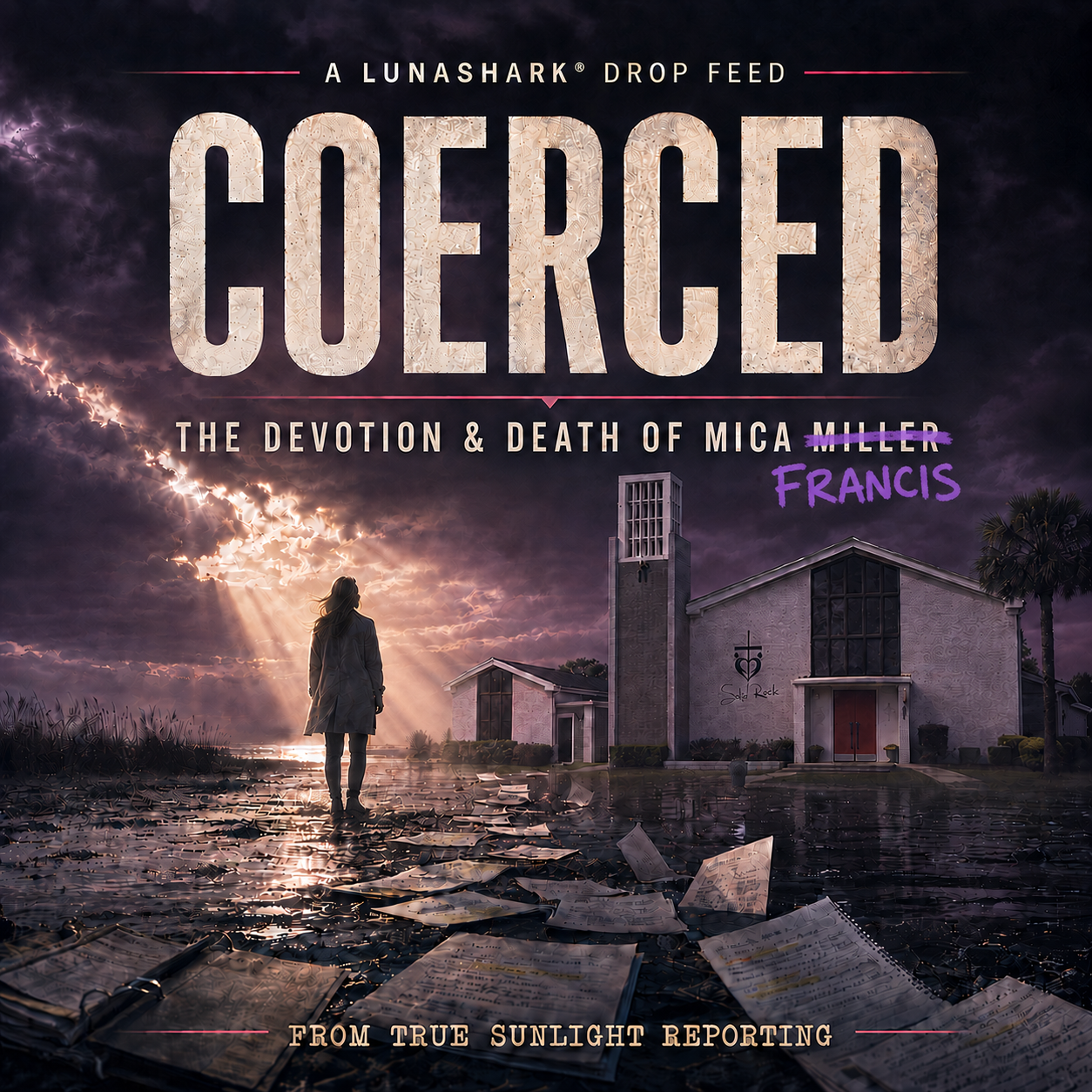
COERCED: The Devotion and Death of Mica Francis Miller is a LUNASHARK® DROP-FEED from the award-winning team behind the Murdaugh Murders Podcast — investigative journalists Mandy Matney, Liz Farrell, and Beth Braden — along with producers Kate Thomas, Grace Hills, and David Moses. It's a remastered, chronological retelling of more than 2 years of original reporting from the True Sunlight® Podcast, built for listeners who want to follow one case.
Mica’s story has been told over 50+ episodes of the True Sunlight Podcast. But what if someone wanted to understand the story without first listening to all of the previous episodes?
That is where part of my work as a digital librarian came in. To help build the foundation for the series, I worked through LUNASHARK's existing podcast library using Mandy's outline for the story as a guide.
And it is a substantial collection.
Between Murdaugh Murders Podcast, True Sunlight Podcast, and Cup of Justice, LUNASHARK Media has produced more than 450 episodes. More than 160 of those were episodes of True Sunlight alone.
Fortunately, I did not have to start from square one as I dug into this new project.
Organization becomes retrieval
One of the tools I maintain is an episode tracker that records information about previously published episodes. When I originally created it, I was working on developing a list of tags for my case document library. Since then, I have come back to that episode tracker time and time again for purposes I never anticipated when I built it.
When it was time to identify the episodes containing reporting on Mica, I could use that existing structure to quickly narrow more than 160 episodes into a much smaller and more useful set. From there, I reviewed the relevant reporting, identified material connected to the developing episode outlines, pulled audio clips, and helped organize information that could support the production process.
This is one of the most important parts of information work: organization is not the end goal. Usability is. You can organize information to your heart’s content, but if someone else cannot find what they need, understand the structure, or make use of it, then the system is not doing its job.
That is what makes retrieval so important. Good organization should make information easier to find, easier to understand, and easier to use.
We do not organize information simply because neat categories are satisfying, although I will admit it scratches an itch in my brain when I can make sense and order out of a pile of information, real or digital.
From archive to story
There was another layer to the COERCED project beyond simply finding relevant episodes. The reporting on Mica had developed over many months as new information emerged. Listeners following True Sunlight Podcast experienced that reporting in real time, but a limited series works differently.
That meant looking not just for where Mica had been discussed, but what had been reported, when it had been reported, how different pieces connected, and which material was most useful to the story being constructed. That process is a big part of information work: finding the right pieces, understanding how they fit together, and making them useful to someone else.
My work can involve maintaining a digital document library, organizing case materials, creating timelines, curating resources, developing information-literacy content, or digging through hundreds of podcast episodes to locate a few minutes of reporting.
Developing those core skills makes it easier to apply them across different formats and projects. At the end of the day, much of this work comes down to taking a mountain of information and making it findable, useful, understandable, and trustworthy.
And occasionally, that mountain happens to be 450 podcast episodes tall.
